
Key findings:
Since 2013, a larger percentage of road deaths have involved drugs than alcohol, distraction, or speeding.
The number of road deaths involving at least one drug-positive driver climbed to 571 in 2023, up from 487 in 2019 and 230 in 2000.
Drug-related fatalities accounted for approximately two in five (41.2%) road deaths in 2023, up from one in three (35%) in 2019 and one in ten (10.7%) in 2000.
Ottawa, Ontario--(Newsfile Corp. - July 31, 2026) - The Traffic Injury Research Foundation (TIRF), with sponsorship from Desjardins Insurance, released a new fact sheet, Drug Use in Fatal Collisions in Canada | 2000-2023. Key findings from an analysis of TIRF's National Fatality Database reveal the presence of drugs has overtaken alcohol as the leading factor in motor vehicle deaths, highlighting a growing risk for Canadian drivers.
In 2023, the most recent data year available, road deaths involving at least one driver who tested positive for drugs (e.g., cannabis, illicit drugs, prescription drugs, and over-the-counter medications) climbed to 571, up from 487 in 2019 and more than double the 230 deaths recorded in 2000. These drug-related road fatalities represented two-fifths (41.2%) of all road deaths in 2023, up from more than one-third (35%) in 2019 and one-tenth (10.7%) in 2000. Since 2013, a larger percentage of road deaths has involved drugs other than alcohol, distraction, or speeding. By comparison, less than one in three (29.3%) road deaths were alcohol-related in Canada in 2023.
"For decades, alcohol has been the primary focus of impaired driving strategies, but the data are telling us a new story that requires different solutions," said Ward Vanlaar, TIRF COO. "Drug impairment is no longer a minor concern on our roads; it is now the leading factor in fatal collisions. Greater investment in policing, tailored approaches to education, and enhanced awareness efforts are necessary to tackle this problem, which is different from the long-prioritized alcohol risk profile."
The data also point to notable differences in the drivers most affected. Between 2019 and 2023, drug-positive results were nearly equal among fatally injured male (54.1%) and female drivers (52.2%), whereas historically a much larger proportion of male drivers killed tested positive for alcohol compared to females. Also, a much larger proportion (63.8%) of younger adults aged 25-34 tested positive for drugs, compared to approximately two in five drivers aged 16-19 (42.1%) and those 65 and older (43.8%). Notably, half of drivers killed in drug-related collisions were the sole occupant (50.6%), whereas about one-third (35.6%) died in vehicles with two or more occupants. There was only a more modest difference in the percentage of persons killed in drug-related collisions at night (41.7%) compared to daytime hours (36.8%).
Furthermore, cannabis use among fatally injured drivers has grown since the legalization of recreational cannabis in October 2018. Prior to this date, 22.4% of drivers dying tested positive for cannabis, whereas post-legalization, that figure rose to 27%.
"These numbers underscore we need to shift our focus on impaired driving to acknowledge the different characteristics of drug-impaired drivers," said Steve Brown, TIRF Research Associate & Data Collection. "Male and female drivers in their late twenties and early thirties, and those driving alone during daytime as well as nighttime hours, account for a significant portion of the problem. Alignment with these factors is needed in prevention messaging, awareness efforts and enforcement resources to optimize these strategies. Concerted efforts are also needed to combat widespread misperceptions. Cannabis does impair skills needed for safe driving and combining it with alcohol further amplifies risk. It is not safe to consume cannabis before driving."
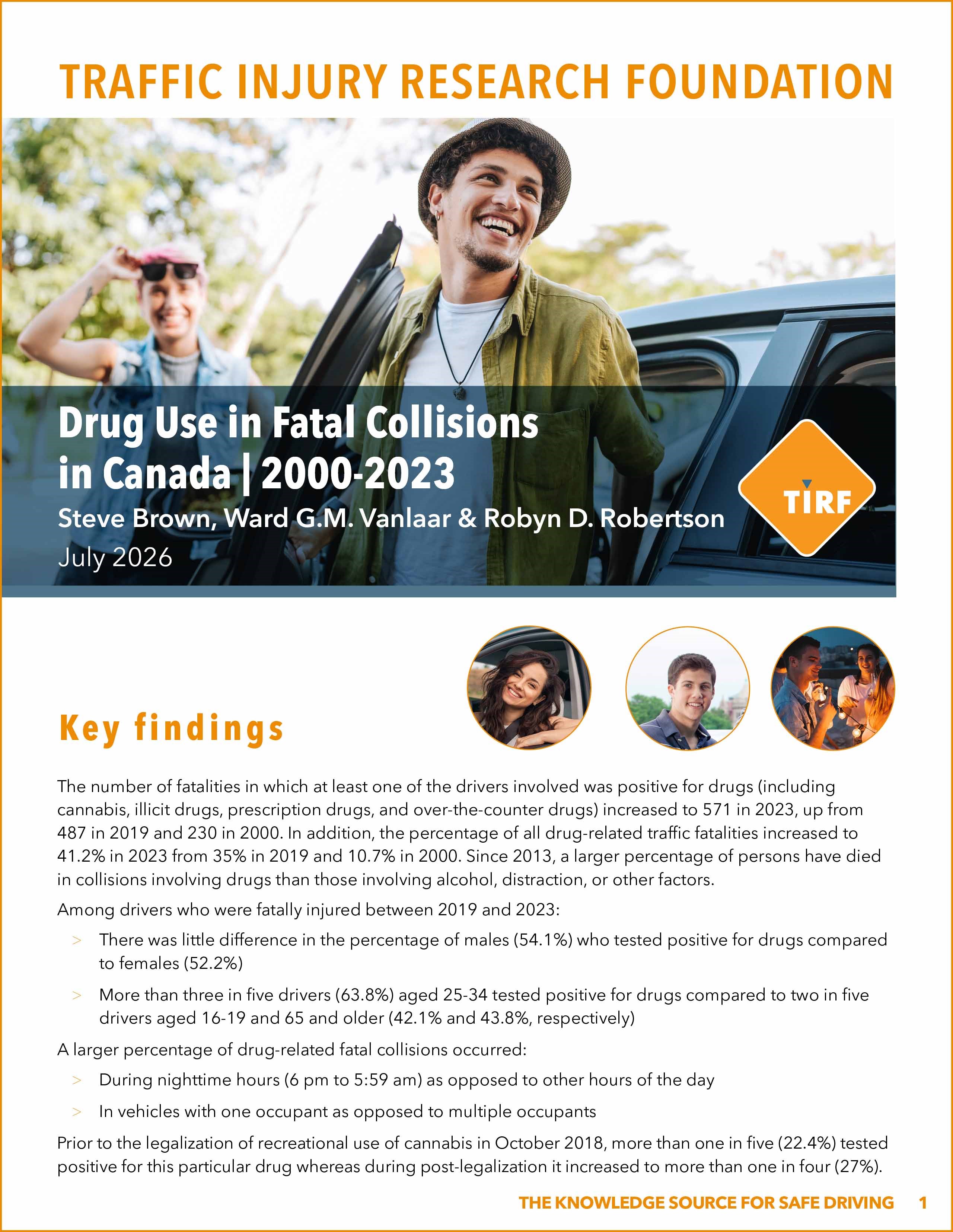
Drug Fatal Collisions 2000-2023
To view an enhanced version of this graphic, please visit:
https://images.newsfilecorp.com/files/10180/307321_8afe8222d457f948_001full.jpg
Download the fact sheet:
About TIRF Canada:
The vision of the Traffic Injury Research Foundation (TIRF) is to ensure people using roads make it home safely every day by eliminating road deaths, serious injuries and their social costs. TIRF's mission is to be the knowledge source for safe road users and a world leader in research, program and policy development, evaluation, and knowledge transfer. TIRF is a registered charity and depends on grants, awards, and donations to provide services for the public. Visit www.tirf.ca or find all TIRF websites and social media at https://linktr.ee/tirfcanada.
– 30 –
For more information, contact:
Karen Bowman
Director, Communications & Programs
Traffic Injury Research Foundation
613 238-5235 (office) | 1 877 238-5235 (toll-free) | karenb@tirf.ca

To view the source version of this press release, please visit https://www.newsfilecorp.com/release/307321